How to learn building AI agents as a business owner is to pick seven real chores, build one agent for each, and go from the easiest to the hardest.
You start with a daily recap that lands on your phone, and you finish with a dashboard that holds every agent you've made.
Each build teaches one idea, and each one keeps working for your business after the lesson is over.
I've run all seven in my own business and published the results, so every example below is a real one.
You won't need to write code for the first six, and I'll explain when the code route is worth it.
The Short Answer: Seven Chores, Seven Agents
Here is the whole ladder, written as the jobs it takes off your desk.
| Build | The chore it takes over | What it teaches you | Extra cost |
|---|---|---|---|
| 1. Daily recap | Working out what matters this morning | Scheduling an agent | None |
| 2. Inbox triage | Sorting email before you can start work | Tools and permissions | None |
| 3. News radar | Scrolling for what's happening in your niche | Live data and structured answers | Depends on the model |
| 4. Second brain | Re-explaining your business to every AI | Memory | None |
| 5. SOP skill | Answering the same team questions again | Reusable skills | One full read of the document |
| 6. Kanban build line | Babysitting every build yourself | Agents working as a team | None on free models |
| 7. Agent OS dashboard | Juggling a dozen AI tabs | System design | None to build it yourself |
What "Building An AI Agent" Actually Means For A Business
An AI agent is a model that has tools, a goal and permission to keep going without you typing each step.
A chat app waits for you, and an agent keeps working after you close the window.
Building one doesn't have to mean programming.
Most business owners should start with a harness, which is a ready-made agent such as Hermes Agent from Nous Research.
Hermes is free and open source, it runs on your own machine, and you connect whichever model you like.
You install it with one line and connect a model with hermes setup.
curl -fsSL https://hermes-agent.nousresearch.com/install.sh | bash
The approach I teach is simple, which is one agent doing one job, on a free model first.
Build 1: The Daily Recap That Starts Your Morning
The business use: You wake up to a short list of what matters today, so you don't open five apps to work it out.
What you learn: You learn that an agent can run on a timetable and deliver to you.
You set it up with one command.
hermes cron create "0 6 * * *" "Read my task list and send me a short to-do recap for today" --name "Daily 6AM To-Do Recap" --deliver telegram
I showed my own version in my Herald OS video, next to a daily Japanese practice session and a morning inbox triage.
You're done when: The recap has arrived three mornings in a row without you touching anything.
What goes wrong: Most first attempts fail because the prompt isn't self-contained, so write it as if the agent has never met you.
The second failure is delivery, which you fix by connecting Telegram with hermes gateway setup.
🔥 Want my exact How To Learn Building AI Agents setup, step by step? Inside the AI Profit Boardroom you get step-by-step video trainings, my installable Agent OS and four coaching calls a week with 3,400+ members building real automations. → Join the AI Profit Boardroom
Build 2: The Inbox Triage Agent For A Busy Owner
The business use: Your inbox is sorted before you sit down, with the five threads that need you at the top and draft replies waiting.
What you learn: You learn that tools and permissions are the real design decisions in any agent.
Hermes ships a built-in skill called email-inbox-triage, which is described as prioritising threads and drafting replies safely.
You connect your mailbox through one of its related mail skills, which are himalaya and google-workspace.
Then you attach the skill to a morning job with the --skill flag.
You're done when: The agent's top five matches your own top five for a working week, and it hasn't sent a single email without you.
What goes wrong: Owners give the agent the power to send on day one, and I'd keep it on drafts until it has earned more.
The other problem is a fuzzy idea of "important", so tell it which clients, words and senders always come first.
Build 3: The Research Radar For Creators And Agencies
The business use: You stop scrolling for an hour every morning, because the agent has already ranked what's breaking in your niche.
What you learn: You learn how to give an agent live data and make it answer in a fixed shape.
My radar is one hermes -z run with a strict prompt, fired at 6am by a scheduled job.
It returns six signals with a headline, a heat score out of 100, the real post and a content angle.
The top three are pushed to my phone with hermes send.
My Hermes Oracle AI guide shows 49 mornings logged, 294 trends scored and 46 pages published from those trends.
You're done when: Six scored signals with real links are waiting for you every morning for a week.
What goes wrong: Only xAI models carry the live X search tool, so I pin that run with --provider xai-oauth --model grok-4.
Live search also returns an empty sweep now and then, and a single retry on empty fixes most of those days.
🔥 Want these builds set up with you, not just explained? Inside the AI Profit Boardroom, you get my installable Agent OS, courses on Hermes Agent and four coaching calls a week with 3,400+ members who are building the same agents. → Get access here
Build 4: The Second Brain That Knows Your Business
The business use: Every agent already knows your offers, your customers and your voice, so you stop briefing from scratch.
What you learn: You learn memory, which is the difference between a clever stranger and a trained team member.
You make a vault in Obsidian, give Hermes the full folder path and ask it to build the folders.
Please give it the real path, because I skipped that while filming and Hermes built the folders in its own workspace.
Then you write one "about" page, and you can let the AI interview you so you aren't staring at a blank page.
My vault held 614 notes when I measured it for my Hermes second brain guide, which doesn't fit in any chat window.
That's why the agent reads the short "about" page first and only then opens what it needs.
You're done when: A brand new chat answers a question about your business correctly and tells you which notes it used.
What goes wrong: People pour every document they own into the vault and wonder why the answers get worse.
Several agents writing into the same files is the other trap, so each agent gets its own folder.
Build 5: Your SOP Turned Into A Skill
The business use: Your onboarding document, your sales process or your favourite business book becomes something the agent can answer from forever.
What you learn: You learn what a skill is, which is knowledge the agent loads only when it needs it.
You type /learn in a Hermes chat, followed by the path to the file.
Hermes reads it once and writes an index, a file per chapter, a glossary and a cheat sheet.
I ran it on The Art of War as an epub in my /learn guide.
The engine's own testing on real books reports 24 to 51 times fewer tokens than pasting the whole book into the chat.
You're done when: A fresh session answers three questions you already know the answers to, with no upload.
What goes wrong: Book mode only ships in newer builds, and that caught me out, so run hermes update first.
🚀 Ready to put How To Learn Building AI Agents to work in your business? Inside the AI Profit Boardroom you get step-by-step video trainings, my installable Agent OS and four coaching calls a week with 3,400+ members building real automations. → Join the AI Profit Boardroom
Build 6: The Kanban Build Line For Agencies And Builders
The business use: You write a ticket, walk away, and come back to a finished landing page, tool or report.
What you learn: You learn orchestration, which is splitting work into tickets and letting separate agents finish them.
You create a board with hermes kanban boards create my-builds, and you add tickets with hermes kanban create.
Each worker is a Hermes profile, so one can be your builder and another can be your reviewer.
In my Hermes Command Desk guide three tickets reached done without me, which were a landing page, a content kanban app and an analytics dashboard.
Those builds ran on free models, so they cost me $0.00.
You're done when: Three tickets are in the done column, and you have opened each result and checked it yourself.
What goes wrong: My first three dispatches died instantly because of config traps, and my kanban build line guide walks through all three.
Day to day, a vague ticket is the thing that wastes the most time.
Build 7: Your Own Agent OS Dashboard
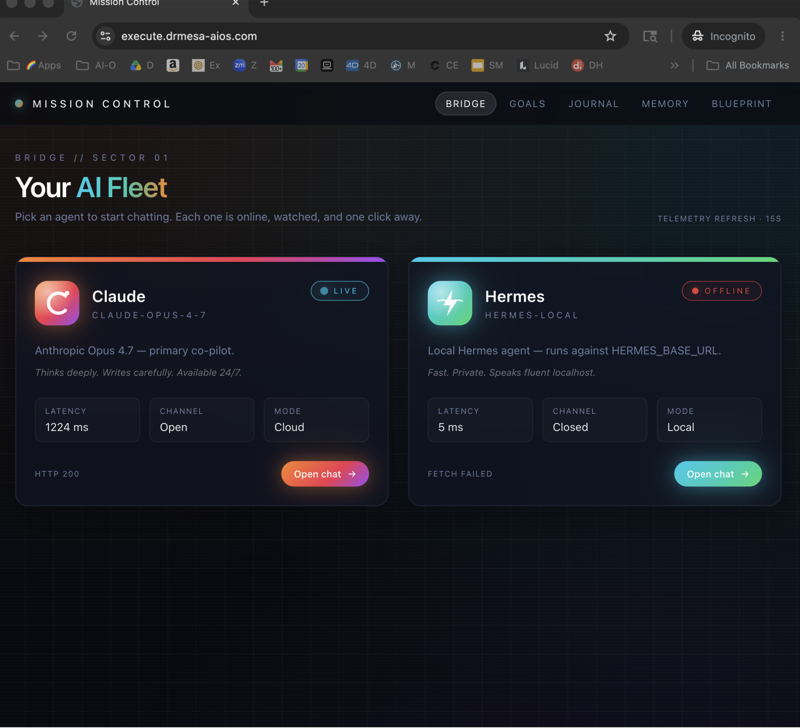
The business use: Everything above lives on one page, with one memory, and you can open it from your phone.
What you learn: You learn how the pieces fit together, which is the skill that separates a tinkerer from an operator.
You install Claude Code, describe the dashboard in plain English and let it build.
Then you look at the result and say what's wrong, and that loop is the entire method.
My free Agent OS guide gives the exact prompts in five steps, from the dashboard to phone access through Tailscale.
You're done when: One page shows your agents, your memory and your board, and it loads on your phone.
What goes wrong: People install every agent in one weekend, and I'd start with Claude Code plus one more.
The order I teach for any task is manual first, then assisted, then automated.
Which Track Fits You: No-Code Harness Or Code?
| You are | The track I'd pick | The reason |
|---|---|---|
| A business owner | No-code harness route | You need agents doing work this week, not a codebase to maintain. |
| An agency | No-code harness route first | Builds one to six cover research, content, reporting and delivery. |
| A creator | No-code harness route | The radar and the second brain are the two builds you'll use daily. |
| A developer or a software company | Code route | You want agents inside your own product, with your own logic. |
The code route means using an agents SDK inside a program you write.
These are the frameworks I checked are live today on their own documentation pages.
- The OpenAI Agents SDK comes from OpenAI.
- The Claude Agent SDK comes from Anthropic.
- LangGraph comes from LangChain.
- The Agent Development Kit comes from Google.
- smolagents comes from Hugging Face.
- CrewAI is built around crews of agents.
I teach the harness route, so I'm pointing you to those docs and not claiming I've shipped a build with each of them.
Hugging Face also has a free AI Agents Course if you'd like lessons for the code route.
What It Costs To Learn This Way
Hermes Agent is free and open source.
Obsidian is a free download, and the Agent OS guide uses Tailscale's free plan for phone access.
The model is the one cost that varies, and a free or local model is enough for the first few builds.
A scheduled job that calls a model uses tokens on every run, so keep the early prompts short.
I can't promise you any income from this, and I'd be suspicious of anyone who does.
What I can tell you is which chores these seven builds took off my own desk.
How To Debug An AI Agent When It Lets You Down
You don't need to be technical to debug an agent, but you do need to look before you guess.
- Run
hermes doctorto check the install is healthy. - Run
hermes logs --level ERROR --since 1hto read what failed in the last hour. - Run
hermes cron runsto see whether a scheduled job actually ran. - Run
hermes kanban showwith the ticket id to read what a worker did. - Run
hermes pauseif something is misbehaving, because it stops scheduled and ticket work until you runhermes resume.
Then change one thing, run it by hand and check the result before you schedule it again.
Most of my own failures came down to a vague prompt, a missing connection or the wrong model for the tool.
💡 Ready to build with a room full of operators? The AI Profit Boardroom is where I share the automations, the memory setup and the build line as trainings, with coaching calls where you can share your screen. → Join the AI Profit Boardroom
A 30-Day Plan For A Busy Owner
In days one to four, install Hermes and get the daily recap working.
In days five to nine, add the inbox triage agent on drafts only.
In days ten to fourteen, build the radar and read it every morning.
In days fifteen to nineteen, make the vault and finish the "about" page.
In days twenty to twenty-three, turn one SOP into a skill.
In days twenty-four to twenty-seven, ship three tickets on a kanban board.
In the last three days, start the dashboard and add one agent to it.
Related Reading
- How to learn AI agents is the wider path for someone who hasn't touched an agent yet.
- How to learn creating AI agents is the sibling guide to this one.
- The best AI agent course in 2026 is my ranked list if you'd like structured lessons too.
- The best Hermes Agent use cases for a business gives you more jobs to hand over.
Also On Our Network
- 🌐 The exact commands for all seven agent builds
- 🌐 The seven builds and both learning tracks, scored
- 🌐 How the seven builds snap together into an Agent OS
- 🌐 The right model for each build, with live bench scores
FAQ: How To Learn Building AI Agents
How can a business owner learn building AI agents?
You pick a real chore and build one small agent for it, and then you repeat with a harder chore.
The order on this page runs from a daily recap up to a dashboard that holds every agent.
Can I build AI agents without coding?
Yes, you can build agents without coding.
A ready-made agent such as Hermes already has the loop, the tools, the memory and the scheduler.
How much does it cost to learn building AI agents?
The tools on this ladder are free to start.
The model you connect may cost money unless you choose a free or local one.
Which AI agent should a business build first?
A scheduled daily recap is the best first build.
It takes one command, and it shows your team what an always-on agent feels like.
Will building AI agents make my business money?
Nobody can promise that, and I won't.
These builds take repeating work off your desk, and what you do with that time is up to you.
📺 Video notes + links to the tools 👉
🎥 Learn how I make these videos 👉
🆓 Get a FREE AI Course + Community + 1,000 AI Agents 👉
About Julian
I'm Julian Goldie, an SEO entrepreneur, author and founder of the AI Profit Boardroom, which has 3,400+ members.
I help business owners scale with AI agents, automation and SEO.
- I founded Goldie Agency, a 7-figure SEO and link-building agency based in Bangkok.
- I've grown a YouTube channel to 400,000+ subscribers.
- I wrote "Link Building Mastery", which is available on Amazon.
- I run GoldieBench and agentos.guide, where I publish my AI model tests and free Agent OS guides.
→ Get my best AI training inside the AI Profit Boardroom
Pick the chore that annoys you most, build one agent for it this week, and that is how to learn building AI agents.