The best Hermes Agent use cases for a business start with daily scheduled automations, such as an inbox triage and a 6am to-do recap that land before you sit down.
After that, I'd put an SEO content pipeline second and a company second brain third.
Hermes Agent is a free, open-source AI agent made by Nous Research, and it runs on your own computer or server with the model you choose.
The difference between Hermes and a chat app is that Hermes keeps working when you close the window.
That's why business owners keep asking me what to actually do with it.
So here are my 11 ranked picks, taken from what I run in my own business and have published guides on.
For each one I'll tell you what it does, what it replaces, how you set it up and what happened when I ran it.
Top 3 Picks For A Business At A Glance
- 🥇 Daily scheduled automations are the best first use case, because they remove small daily chores such as inbox sorting and task planning.
- 🥈 An SEO content pipeline is second, because content that ranks keeps bringing visitors long after it's published.
- 🥉 A company second brain is third, because an agent that knows your offers, numbers and voice gives better answers on every other job.
How I Ranked These Use Cases For Business
I ranked each use case on four questions a business owner would ask.
Does it remove a job that someone on the team does every day or every week?
Can a non-technical person set it up in an afternoon?
Does it keep costs low once it's running?
Have I run it myself, with results I can show you?
This is my own ranking from my own business, so please treat it as experience and not as a study.
🔥 Want my exact 11 Best Hermes Agent Use Cases For A Business setup, step by step? Inside the AI Profit Boardroom you get step-by-step video trainings, my installable Agent OS and four coaching calls a week with 3,400+ members building real automations. → Join the AI Profit Boardroom
The 11 Best Hermes Agent Use Cases For A Business, Ranked
1. Daily automations for the boring morning jobs
A daily automation is a task that Hermes runs on a timetable and sends to you.
It replaces the first half hour of your day, when you sort email and work out what to do.
You set one up with the hermes cron create command, or you describe it in plain English and let Hermes build it from an Automation Blueprint.
In my own setup I run a daily 6am to-do recap, a morning inbox summary, an inbox triage and an evening wrap-up.
I also have a daily Japanese practice session scheduled, which I showed in my Herald OS video.
Best for: Owners and managers who start every day in their inbox.
Cost: The agent is free, and each run uses a small number of model tokens.
2. An SEO content pipeline that feeds itself
An SEO content pipeline finds the keywords you nearly rank for, writes the posts and publishes them.
It replaces the weekly cycle of keyword research, briefing, writing and uploading.
The loop reads Google Search Console, scores every keyword, writes a unique post per site and deploys it.
I run that loop from my Agent OS, where Hermes works next to Claude and my other agents.
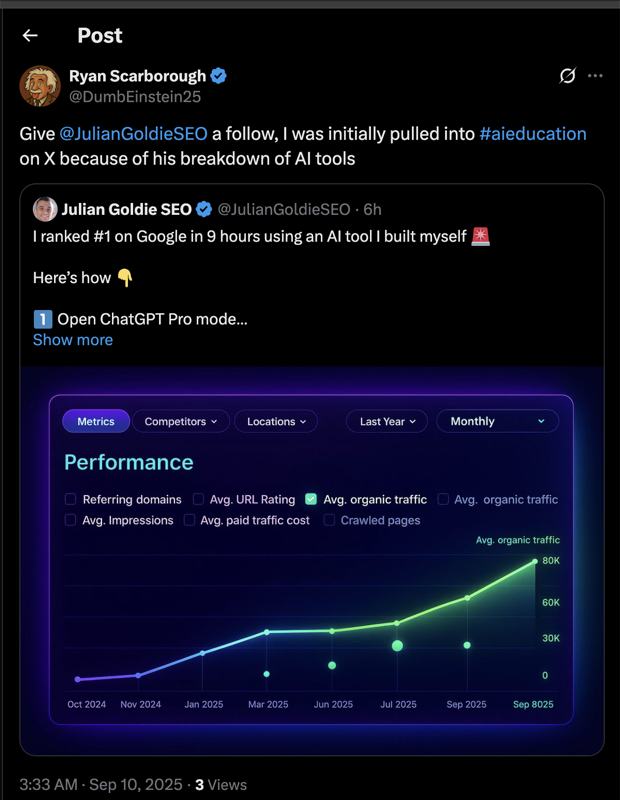
In my Claude AI SEO guide a brand new page reached page one of Google in 14 hours.
One of my sites earned 4,310 clicks from 122,674 impressions in 90 days using that system.
My Infinite Ranking Engine guide shows the full 16-month view for one site, which is 42.2K clicks and 1.91M impressions.
Those are my numbers on my sites, and your results will depend on your niche and your starting point.
Best for: Businesses and agencies that already publish content.
Cost: Search Console is free, and the writing cost depends on your model.
3. A company second brain in Obsidian
A second brain is a folder of plain notes that your agent reads before it answers.
It replaces the long briefing you'd otherwise paste into every new chat.
You create a vault in Obsidian, give Hermes the full folder path and ask it to build the structure.
The most important page is a short "about" note that covers who you are, what the business does, your numbers and your voice.
My own vault had 614 notes when I measured it, and the agent still found the right 11 notes to answer a question in my second brain demo.
One example from that guide is asking for the most common sales objections in the last 30 days and getting an answer with the source notes named.
Best for: Any business where knowledge lives in one person's head.
Cost: Obsidian is a free download, and the notes stay on your own disk.
4. A 6am trend radar for content ideas
A trend radar scans your niche every morning and hands you the stories worth covering.
It replaces an hour of scrolling for something to post about.
My version runs at 6am, returns six ranked stories with a suggested angle for each, and sends the top three to my phone.
The Hermes Oracle AI guide shows what it logged, which is 49 mornings, 294 trends scored and 46 pages published from those trends.
Best for: Creators, newsletters and media-led brands.
Cost: The sweep runs through my existing X login, so it has no fee per run.
5. Turning your SOPs and books into skills
The /learn command reads a document once and turns it into a permanent skill.
It replaces the habit of pasting the same PDF into a chat window again and again.
You type /learn followed by the file location, and Hermes writes an index, chapter files, a glossary and a cheat sheet.
I ran it on The Art of War as a test, and the full run is in my /learn guide.
For a business, the best first documents are your SOPs, your onboarding guide and your sales playbook.
Best for: Teams that keep answering the same internal questions.
Cost: You pay for one full read, and later answers use far fewer tokens.
6. A build line for pages, tools and dashboards
A kanban build line lets you drop a ticket on a board and have a Hermes worker build it.
It replaces the back-and-forth of prompting one build at a time.
You create a board with hermes kanban boards create, add tickets and let the dispatcher hand them to workers.
In my Command Desk guide three tickets were finished without me, which were a landing page, a content kanban app and an analytics dashboard.
They ran on free models, so those three builds cost me $0.00.
Best for: Agencies and founders who need simple pages and internal tools.
Cost: It can be free on free or local models.
7. A watcher that tells you when something changes
The /loop command makes Hermes keep checking one thing until it changes.
It replaces refreshing a page all afternoon.
In my own work I use it to wait for new pages to be indexed and to watch a content board for stalled work.
You can set a fixed interval, or you can let the agent slow itself down while nothing is happening.
The details are in my /loop guide.
Best for: Launches, migrations and anything you check by hand.
Cost: Each check uses tokens, so the self-paced mode keeps the bill down.
8. Outreach and lead generation
An outreach engine finds real contacts, verifies every email address and drafts a personal first message.
It replaces a lead finder, a verifier and a sending tool.
I'll be honest about why I built mine.
My first cold email campaign sent 6 emails and had 9 bounce, and the whole thing was flagged and cancelled.
The engine in my lead machine guide found 23 leads on one run and held back 9 bad addresses before they were sent.
It also scores each lead from 0 to 100, so you spend your time on the best fits.
Best for: Agencies, consultants and B2B service businesses.
Cost: Hunter's free tier covers about 25 checks a month, and the guide puts real volume at around $34 a month.
9. A voice assistant for hands-free work
Voice mode lets you speak to Hermes and hear the reply.
It replaces typing when your hands are busy.
You switch on the wake word, say "hey hermes" and ask your question.
The listening runs on your own machine, so it costs nothing until you actually speak a command.
A good business use is a spoken daily briefing of your open tasks, which I show in my wake word guide.
Best for: Owners who think out loud and want a quick answer.
Cost: It's free to listen, and each spoken command uses normal model tokens.
10. Reaching your agent from any device
The Hermes Tailscale plugin lets you control Hermes Desktop from your phone and laptop.
It replaces the need to be at your desk to check on a job.
You install it in one click from the Hermes plugins directory, after reading the plugin's GitHub page.
Best for: Owners who travel and leave the agent running at home or in the office.
Cost: The plugin is free.
11. A panel of models for big decisions
Mixture of Agents sends one question to several AI models and merges their best points into one reply.
It replaces asking three different chat apps and comparing the answers yourself.
You choose the models with hermes moa configure and ask with /moa.
Nous Research claims strong benchmark gains for it, but the benchmark isn't public yet, so I keep an open mind.
Best for: Pricing, positioning and other decisions you only make once.
Cost: It costs more than any other use case, because several models answer each prompt.
The Best Hermes Agent Use Cases Compared For Business
| Rank | Use case | What it replaces | Who owns it | Extra cost beyond the model |
|---|---|---|---|---|
| 1 | Daily automations | Morning inbox sorting and task planning | The owner or an assistant | None |
| 2 | SEO content pipeline | Manual keyword research and uploading | Marketing | None |
| 3 | Second brain | Re-briefing the AI every session | Everyone | None |
| 4 | Trend radar | Scrolling for content ideas | Content | None on my setup |
| 5 | SOP and book skills | Pasting the same documents into chats | Operations | None |
| 6 | Build line | One-at-a-time prompting for builds | Product or the agency team | None |
| 7 | Watchers | Refreshing pages by hand | Operations | None |
| 8 | Outreach and leads | A finder, a verifier and a sender | Sales | A Hunter plan for volume |
| 9 | Voice assistant | Typing quick questions | The owner | None |
| 10 | Multi-device access | Being tied to one desk | The owner | None |
| 11 | Mixture of Agents | Comparing several chat apps | Leadership | Several models per prompt |
🔥 Want to see how I run these inside a real business? Inside the AI Profit Boardroom, I walk through my Hermes automations, the SEO loop and the outreach setup step by step. You'll be in a community of 3,400+ members with four coaching calls a week. → Get access here
How A Business Actually Gets Started With Hermes Agent
Here's the simple route I'd follow if I were setting this up for a small team.
First, install Hermes Agent on one machine that stays switched on, using the official install script.
Second, run hermes setup and connect a model, which can be a paid plan you already have or a free one.
Third, write the "about" page for your business in an Obsidian vault.
Fourth, schedule one morning automation and let it run for a week.
Fifth, add the one use case from the list that matches your biggest weekly time sink.
That order matters, because automations give you a quick win and the second brain makes everything after it better.
If you want more ideas for jobs to hand over, my post on AI automation for small business covers seven of them.
Three Business Setups Built From These Use Cases
Most businesses don't need all 11, so here are three combinations that make sense.
The solo creator
A solo creator should run the trend radar, the daily automations and the second brain.
The radar gives you the day's topics, the automation gives you the plan and the vault keeps your voice consistent.
The agency
An agency should run the SEO pipeline, the outreach engine and the kanban build line.
The pipeline handles client content, the engine fills the top of your funnel and the build line produces pages and dashboards.
I'd keep every client in a separate space, which is the answer I give when members ask how to handle several companies in one agent.
If you're building an agency from scratch, my guide on how to start an AI agency covers the offer side.
The local or service business
A local business should run the daily automations, the SOP skills and the voice assistant.
That gives the owner a sorted inbox, a team that can ask the handbook questions and a hands-free way to check the day.
If you'd like my team to look at how AI and SEO could bring your business more customers, you can book a free strategy session and leave with a custom plan.
What The Best Hermes Agent Use Cases Cost To Run
Hermes Agent is free, so the costs come from three other places.
The first is the model, and you control that by choosing a free, local or paid brain for each job.
The second is extra services, and the only one in this list is Hunter for checking email addresses.
The third is your own setup time, which is usually an afternoon for the first use case.
I route everyday jobs to free and local models and keep paid models for the hard work.
A scheduled job that only runs a script can skip the model entirely with the --no-agent flag, which makes it free to run.
The Honest Limits A Business Should Know
Hermes Agent is powerful, but there are limits I'd want you to know before you rely on it.
- An agent can make mistakes, so I keep approval switched on for anything that sends a message to a customer.
- Community plugins are written by other people, so I read the GitHub page before I install one.
- A hosted model sees whatever you send it, so I read the provider's data terms before I share client files.
- Cold email only works when every address is real and verified, which is the lesson my bounced campaign taught me.
- Search results are never guaranteed, and my SEO numbers come from my own sites with more than a decade of SEO experience behind them.
- Mixture of Agents multiplies your model spend, so it's the wrong tool for routine jobs.
💡 Want the done-for-you version of this stack? The AI Profit Boardroom includes my installable Agent OS, with Hermes, the memory setup and the automations already wired together, plus coaching calls where we help you set up your own. → Join the AI Profit Boardroom
Which Hermes Agent Use Case Should Your Business Start With?
You should start with daily automations if your mornings disappear into email.
You should start with the SEO pipeline if your site already gets impressions but not enough clicks.
You should start with the second brain if your team keeps asking you the same questions.
You should start with the outreach engine if you sell to other businesses by email.
Whichever you pick, set up one, let it run for a week and only then add the next.
Related Reading
- The best Hermes Agent skills shows which skills are worth adding for business work.
- The best Hermes Agent setup explains the install and model choices behind everything in this post.
- The best Hermes Agent memory options goes deeper on giving the agent your business context.
- Herald OS covers the free desktop where I manage these automations.
Also On Our Network
- 🌐 The exact commands to set up all 11 Hermes Agent use cases
- 🌐 Every Hermes Agent use case scored out of ten
- 🌐 How these use cases fit together in an Agent OS
- 🌐 The best model for each Hermes use case, with real bench scores
FAQ: Best Hermes Agent Use Cases For Business
What are the best Hermes Agent use cases for a small business?
The best three are daily scheduled automations, an SEO content pipeline and a second brain in Obsidian.
Together they cover your mornings, your marketing and your company knowledge.
How much does it cost to run Hermes Agent in a business?
Hermes Agent is free and open source.
Your running cost is the model you connect, which can be free or local, plus any extra service such as Hunter for outreach.
Can an agency use Hermes Agent for client work?
Yes, an agency can use it for content, outreach, research and reporting.
I'd keep each client in its own space, and I'd read the model provider's data terms before sending client files to a hosted model.
Will Hermes Agent make my business money?
Nobody can promise you that.
Hermes Agent saves time on repeat work, and whether that becomes revenue depends on your offer, your market and how you use the hours you get back.
Do I need a developer to set up Hermes Agent?
No, you don't need a developer.
The install is one script, the setup wizard connects your model and most use cases are one command or one plain-English request.
📺 Video notes + links to the tools 👉
🎥 Learn how I make these videos 👉
🆓 Get a FREE AI Course + Community + 1,000 AI Agents 👉
About Julian
I'm Julian Goldie, an SEO entrepreneur, author and founder of the AI Profit Boardroom, which has 3,400+ members.
I help business owners scale with AI agents, automation and SEO.
- I founded Goldie Agency, a 7-figure SEO and link-building agency based in Bangkok.
- I've grown a YouTube channel to 400,000+ subscribers.
- I wrote "Link Building Mastery", which is available on Amazon.
- I run GoldieBench and agentos.guide, where I publish my AI model tests and free Agent OS guides.
→ Get my best AI training inside the AI Profit Boardroom
Start with one morning job and build from there, because that's how you get real value from the best Hermes Agent use cases.