Hermes Agent dashboards are the screens that show a business what its AI agent is actually doing, from the conversations it had to the money it spent.
Hermes Agent is the free, open-source agent from Nous Research, and its built-in dashboard opens with one command, hermes dashboard.
Around it sit eight more options, which are the kanban board, Hermes Desktop, Herald OS, Hermes Workspace, Hermes WebUI, Hermes Pixel Office, Hermes3D and my own Agent OS.
I'll show you which screen answers which business question, and then how an owner, an agency and a creator would each use them.
What Hermes Agent Dashboards Are, In Plain English
An AI agent that works in a terminal is hard to manage, because you cannot see what it did while you were away.
A dashboard fixes that by showing the agent's state on a screen you can read in a few seconds.
The official Hermes docs say every front-end talks to the same agent and shares state, so each dashboard is a different window onto one worker.
That means you are not choosing one dashboard for life.
You are choosing the right window for the question you have this morning.
Every fact below comes from the official Hermes docs, each project's own GitHub page, or my own use, and I checked them on 14 October 2026.
Which Hermes Agent Dashboard Answers Which Business Question
| The business question | What you want to see | The dashboard that shows it |
|---|---|---|
| What did the agent actually do? | Sessions | The Sessions page of the built-in dashboard |
| What is this costing me? | Costs and tokens | The Analytics page of the built-in dashboard |
| What is being worked on right now? | Kanban and tasks | The Kanban tab of the built-in dashboard |
| What does the agent know about my business? | Memory | The Memory Graph in Hermes Desktop |
| What runs while I'm asleep? | Cron jobs | The Cron page of the built-in dashboard |
| Who is working and who is stuck? | A multi-agent office | Hermes Pixel Office |
Four of those six answers sit inside the dashboard that ships with Hermes, which is why I tell every business owner to start there.
The Problem These Dashboards Solve For A Business
A business does not fail with AI because the model is weak.
It fails because nobody can see what the agent is doing, so nobody trusts it with real work.
I run Goldie Agency with 70+ employees, and AI handles a large share of our internal work.
That only works because I can open a screen and check the work, the cost and the schedule without asking anyone.
A dashboard turns an agent from a black box into something you can manage like a member of staff.
🔥 Want my exact How I Use Hermes Agent Dashboards To Run My Business setup, step by step? Inside the AI Profit Boardroom you get step-by-step video trainings, my installable Agent OS and four coaching calls a week with 3,400+ members building real automations. → Join the AI Profit Boardroom
The Six Views A Business Needs
Sessions: What Did The Agent Do?
A session is one conversation or one job, and it is your audit trail.
The Sessions page of the built-in dashboard lists every session with its title, source, model, message count and tool call count.
It separates human chats from automation, so cron runs and API calls do not bury the conversations you care about.
A full-text search covers every message, which is how I find the one answer I half remember from last month.
You can export any session as JSON, which is useful when a client asks what was done on their account.
Hermes Desktop and Hermes WebUI both show the same history in a friendlier list.
Costs And Tokens: What Is This Costing Me?
The Analytics page is the screen I'd show a finance person.
It shows total tokens, the cache hit percentage, the total cost and the number of sessions for the last 7, 30 or 90 days.
A per-model table shows which model did the work and what it cost, so you can see whether an expensive model is doing cheap chores.
Hermes WebUI shows tokens and estimated cost per conversation, and its README says that display is off by default.
Hermes Workspace lists a cost ledger and a model mix on its Dashboard page.
Herald OS has a Usage view, which its README describes as what Hermes used this week and this month, with a warning at 90% of your model plan.
I won't promise you a saving, because your bill depends on the models you choose and how much work you run.
Kanban And Tasks: What Is Being Worked On?
The kanban board is how I hand an agent a job that is too big for one message.
Hermes ships the board as a bundled dashboard plugin, with columns for triage, todo, ready, running, blocked and done.
You run hermes kanban init once, open hermes dashboard, and click the Kanban tab.
You can create a task, assign it to a profile, set a priority and drag the card between columns.
The docs say a task dropped into triage can be broken into smaller tasks automatically and routed to the best-fit profile.
In my own Agent OS, I dropped three build tickets on the board, a landing page, a content kanban app and an analytics dashboard, and Hermes workers moved all three to done.
Hermes Desktop has a Kanban page, and Hermes Workspace has a Kanban TaskBoard that I use as an AI to-do list.
🔥 Want to see the kanban board I use for real client-style work? Inside the AI Profit Boardroom, I walk through the Hermes dashboard, the kanban build line and my Agent OS step by step. You also get four coaching calls a week with 3,400+ members. → Get access here
Memory: What Does The Agent Know About My Business?
Memory decides whether you explain your business once or every single day.
Hermes Desktop has a Memory Graph, which lays out learned skills and memories as a zoomable map with a timeline.
Hermes WebUI lets you view and edit the MEMORY.md and USER.md files inline, and Hermes Workspace lets you browse, search and edit memory.
The built-in dashboard only lets you choose a memory provider and reset the built-in stores, so it is not the place to read memory.
Herald OS has a Memory page, and I spotted my Telegram details in mine.
That is my warning for every business: look at the memory screen before you share it on a client call.
Cron Jobs: What Runs While I'm Asleep?
Cron jobs are scheduled prompts, such as a morning report or a weekly check.
The Cron page of the built-in dashboard shows each job's prompt, schedule, state, delivery target, last run and next run.
You can pause a job, edit it, or trigger it immediately when you want the report now.
A job can deliver to Telegram, Discord, Slack or email, so the result arrives where your team already reads.
Hermes Desktop has a Cron pane, Hermes WebUI calls its version Tasks, and Herald OS calls its version Automations.
My automations synced across Herald OS, Hermes Desktop and my Agent OS, because all three read the same Hermes.
A Multi-Agent Office: Who Is Working And Who Is Stuck?
Once you run several agents, a list of sessions stops being enough.
Hermes Pixel Office is a free plugin by Teknium that shows each session as a pixel character at a desk.
A red exclamation mark appears over any agent that is waiting for your approval, which is the fastest way I know to spot a blocked job.
It only watches, so you still give orders somewhere else.
Hermes3D is a 3D virtual office for AI agents, and it also has a 2D pixel view for low-power machines.
I have not tested Hermes3D, so that description comes from its README, and it is an unofficial project that is not made by Nous Research.
Its last push was in late August 2026 and it has had one release, so I would check the repo before a business relies on it.
My Hermes3D guide covers what the README says it can do.
🚀 Ready to put How I Use Hermes Agent Dashboards To Run My Business to work in your business? Inside the AI Profit Boardroom you get step-by-step video trainings, my installable Agent OS and four coaching calls a week with 3,400+ members building real automations. → Join the AI Profit Boardroom
Match The Dashboard To The Way You Work
If You're A Solo Business Owner
You need two screens and no more.
Open hermes dashboard for costs, schedules and tasks, and use Hermes Desktop for chat and memory.
Check the Analytics page once a week, so a surprise bill never builds up quietly.
If You Run An Agency With Several Clients
Your risk is client work bleeding together.
Hermes profiles are isolated instances with their own config, skills and sessions, and the dashboard has a profile switcher in its sidebar.
The kanban board supports one board per project, with a board switcher at the top of the Kanban tab.
I'd give each client a profile and a board, then export sessions when a client asks for a record.
Herald OS adds Spaces, which I'd use to keep each client's work in its own area.
If You're A Creator Or You Work On The Move
You want your agent on your phone.
Hermes WebUI is a browser app, and its README describes a mobile layout and remote access through an SSH tunnel or Tailscale.
Its Tasks panel shows your cron jobs with run history, so you can check a scheduled post from anywhere.
If You Manage A Team Of Agents
You want one place to see everyone.
Hermes Workspace lists an Operations view for several agents, a Kanban TaskBoard and a Dashboard with sessions, model mix and a cost ledger.
It needs the Hermes gateway and hermes dashboard running behind it, so it has more moving parts than the others.
Pixel Office then sits on a side screen and tells you who is stuck.
How To Open Each Hermes Agent Dashboard
| Dashboard | Cost | How you open it |
|---|---|---|
| Web dashboard | Free with Hermes | Run hermes dashboard, and it opens 127.0.0.1 on port 9119. |
| Kanban board | Free with Hermes | Run hermes kanban init, then open the Kanban tab of the dashboard. |
| Hermes Desktop | Free | Run hermes desktop, or download the installer. |
| Herald OS | Free, alpha | Install Hermes, then download the build from the releases page. |
| Hermes Workspace | Free | Run the project's one-line installer, then hermes gateway run and pnpm dev. |
| Hermes WebUI | Free | Clone the repo, then run python3 bootstrap.py. |
| Hermes Pixel Office | Free | Clone it into the plugins folder, run hermes plugins enable pixel-office, and open port 8113. |
| Hermes3D | Free | Clone the repo, then run npm install and npm run dev. |
| My Agent OS | Inside the AI Profit Boardroom | Install the zip that members get. |
The model you connect can still cost money, unless you use a free or local one.
Where My Own Agent OS Fits
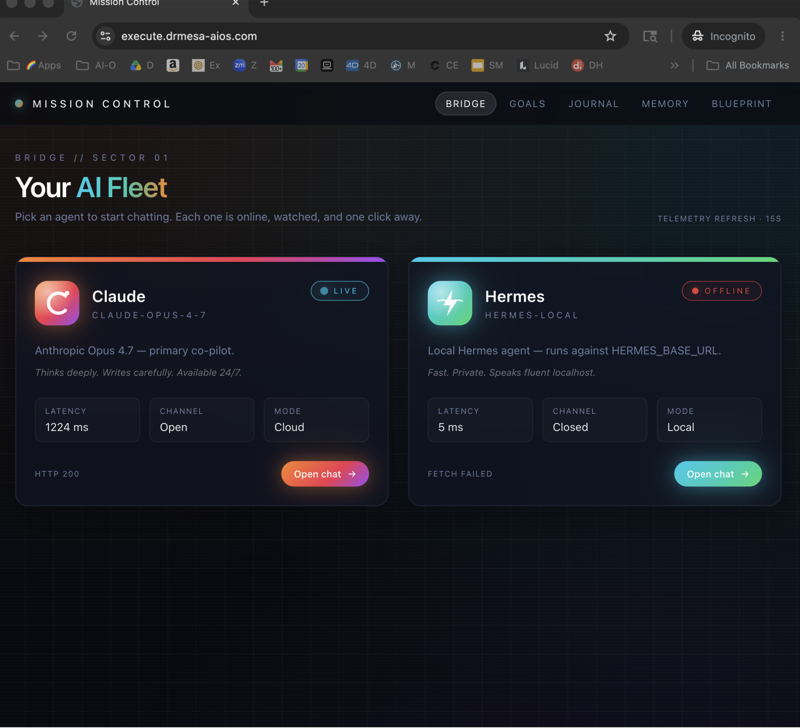
I use my own Agent OS as the one screen for all of this, and I'm biased because I built it.
It gives one Hermes thirteen rooms next to Claude and my other agents, and every exchange saves to my Obsidian vault.
Its Manage room embeds the full Hermes dashboard, so sessions, models, logs, cron jobs and skills are one click away.
Its board is where bigger jobs become tickets, and its Office tab shows the agents at their desks.
It is not on public GitHub, and access is inside the AI Profit Boardroom as an installable zip.
I explain why it is my daily pick in my best UI for Hermes Agent ranking, and this post on the Agent OS and GitHub explains how members get it.
How A Business Should Roll These Out
- Install Hermes Agent and run
hermes dashboardon day one. - Spend the first week checking the Sessions page each morning, so you learn what the agent really does.
- Add one cron job, such as a daily summary, and watch it on the Cron page.
- Run
hermes kanban initand move one real job onto the board. - Check the Analytics page at the end of the week and note which model did the most work.
- Add Hermes Desktop, Pixel Office or a community dashboard only when a real job calls for it.
💡 Want help setting this up for your own business? The AI Profit Boardroom has Hermes trainings, the installable Agent OS and four live coaching calls every week, where you can share your screen. Join 3,400+ members building real automations. → Join the AI Profit Boardroom
Honest Risks To Know Before You Commit
The built-in dashboard reads and writes your keys file, so it binds to your own machine by default.
If you expose it to a network, the docs say it will not start until a password or a sign-in is configured.
The docs also warn that the kanban routes become reachable from the network on a public bind, so don't do that on a shared host.
Herald OS is an alpha at version 0.1, and its Connections page did not sync for me.
Community dashboards are maintained by volunteers, so you keep them updated yourself.
Hermes WebUI's feature list does not describe a kanban board, so check the repo before you plan task tracking around it.
A dashboard shows you the work, but it does not check the quality of the work, so a person still needs to review what ships.
Related Reading
- My best UI for Hermes Agent ranking covers the interface I use every day.
- My Hermes3D guide explains the 3D office from its docs.
- The best Hermes Agent UI for business ranks the free front-ends.
- Hermes Agent for SEO shows the kind of work I put on the board.
Also On Our Network
- 🌐 The exact command to open every Hermes dashboard
- 🌐 Hermes dashboards compared feature by feature, with a verdict
- 🌐 How the Hermes dashboards fit into an Agent OS workflow
- 🌐 What the cost dashboards mean for the model you pick
FAQ: Hermes Agent Dashboards For Business
What are Hermes Agent dashboards used for in a business?
They show what the agent did, what it cost, what it is working on, what it remembers and what is scheduled.
The built-in one opens with hermes dashboard.
Which Hermes Agent dashboard should a small business start with?
Start with the built-in web dashboard, because it ships with Hermes.
Add Hermes Desktop when you want chat and a memory view.
How can I track what Hermes Agent costs my business?
Open the Analytics page of the built-in dashboard.
It shows tokens, cost and a per-model breakdown for 7, 30 or 90 days.
Can an agency keep client work separate in Hermes dashboards?
Yes, it can.
Profiles keep config, skills and sessions apart, and the kanban board supports one board per project.
Is Julian Goldie's Agent OS one of the free Hermes Agent dashboards?
No, it is not.
My Agent OS is not on public GitHub, and access is inside the AI Profit Boardroom.
📺 Video notes + links to the tools 👉
🎥 Learn how I make these videos 👉
🆓 Get a FREE AI Course + Community + 1,000 AI Agents 👉
About Julian
I'm Julian Goldie, an SEO entrepreneur, author and founder of the AI Profit Boardroom, which has 3,400+ members.
I help business owners scale with AI agents, automation and SEO.
- I've built Goldie Agency into a seven-figure SEO and link building agency with 70+ employees.
- I've grown my YouTube channel to 400,000+ subscribers.
- I run my own Agent OS, where AI agents handle a large share of internal work.
- I wrote "Link Building Mastery".
→ Get my best AI training inside the AI Profit Boardroom
Pick the question you most need answered this week, open the screen that shows it, and build out from there with the rest of the Hermes Agent dashboards.